SR 234 in Hancock County

Looking at a highway map of Indiana, there are several roads that make you wonder about their existence. Not that they shouldn’t…but why that particular road was chosen to be added to the system. The purpose of the state highway system, in a broad sense, is to connect all of the county seats in Indiana together. But there are roads that are part of the system that don’t. Such is SR 234 going east from McCordsville.

What is now SR 234 was added to the state road system in the summer of 1932. The first “official” reference to it is on the second Indiana Official State Highway map of 1932. There were two maps issued by the Indiana State Highway Commission in 1932. One was issued at the beginning of the year, which appears to have served as both the 1931 and 1932. (I haven’t found a 1931 Official Map, although I have searched quite a bit.)

The second map of 1932, issued officially on 1 September 1932, was released after a large number of roads were added to the system. As mentioned above, one of those was SR 234 connecting McCordsville to SR 38 between Kenard and New Castle. I should mention here that the SR 234 that was added to the system isn’t exactly the one that is the current route. But I will get to that.

This is where we go back to the Auto Trail era. On 23 October 2019, I did a blog entry about the Hoosier Highway. That road connected Evansville to Detroit. Or that was the goal. As I wrote in that entry, there are very few roads that could have covered more of Indiana than the Hoosier Highway. The section that want to focus on is from Indianapolis to Anderson.

The original route of the Hoosier Highway coming out of Indianapolis was along the Pendleton State Road, at that time called the Pendleton Pike. At McCordsville, instead of following the old Pendleton Pike to Pendleton, it turned east along the road that connected that town to Eden. Eden is located on the old Greenfield-Anderson State Road.

Since the state highway system did not include a direct route from Indianapolis to Anderson until 1923 (using the Pendleton Pike and the replacement for such), traveling between the two cities involved the Hoosier Highway. That highway crossed east from McCordsville to Eden, then north along the Greenfield-Anderson State Road into Pendleton.

With the addition of the Pendleton Pike to the state highway system, the Hoosier Highway between McCordsville and Eden went by the wayside as far as the state was concerned. (The section of the Hoosier Highway from Eden north had already been added as Original State Road 11 from Greenfield north.) The road had been improved to an oil treated gravel road as part of the Hoosier Highway.

Fast forward almost a decade. In Summer 1932, SR 234 was added to the highway system. The number 34 was used around the Indianapolis area to fit into the numbering system put in place on 1 October 1926. See the ITH entry of 12 April 2019, “SR 34 and ‘Daughters’,” for more information on the use of the state road number 34.

The (eastern) SR 234 that was added in the summer of 1932 would use the route of the Hoosier Highway between McCordsville and SR 9. Here, SR 234 turned north about one half mile, then turned east on Eden Road. From there, it followed Eden Road, to Troy Road, to connect to the current SR 234 for the rest of the journey to SR 38 west of New Castle.

The only reason I can see that this road was added to the state highway system is that it created a shorter, more direct, route from New Castle to Indianapolis. It doesn’t really matter now, since it has been part of that highway system for almost 90 years now.

Bankruptcy of the Southern Indiana Railway, Part 3

In May, 2019, I wrote an article about the Milwaukee Road in Indiana. For the last two days, I have been covering the bankruptcy of one of the predecessor roads, the Southern Indiana Railway. Two days ago (Bankruptcy of the Southern Indiana Railway, Part 1), I covered the main line. Yesterday (Bankruptcy of the Southern Indiana Railway, Part 2), I covered the branch lines. A lot of legalese, defining exact locations of what was where. Today I want to focus on the spur lines that were defined in the Notice of Sale.

When compiling the list of railroad property, people don’t realize that it requires a complete detailing of the entire operation. These include spur lines for customers.

A Spur from a point on the main line of The Southern Indiana Railway Company nine-tenths (0.9) miles South of Hulman Street, Terre Haute, Indiana, extending in a Westerly direction One and Eight Tenths (1.8) miles to a Gravel Pit.

A Spur from a point on the main line of The Southern Indiana Railway Company One and One Tenth (1.1) miles North of Coalmont, Indiana, extending in a Westerly direction in Clay and Sullivan Counties, Indiana, to a plant of United States Power Company.

A Spur from a point on the main line of The Southern Indiana Railway Company at Coalmont, Indiana, extending in an Easterly direction Five Tenths (0.5) miles to the Pierson Mine.

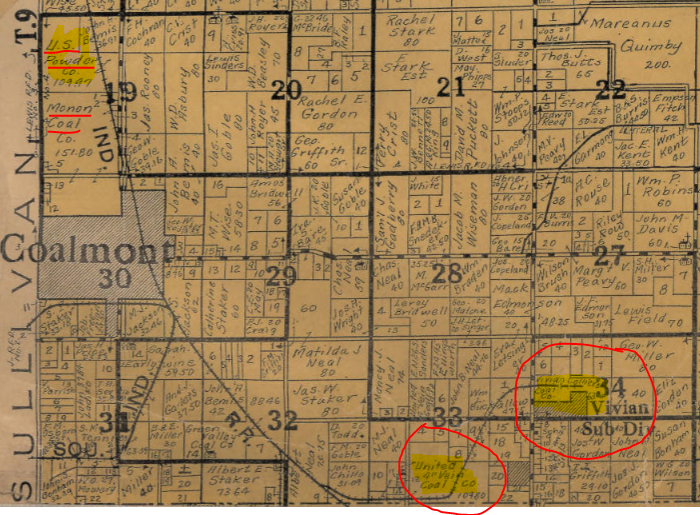
Mines around the Coalmont, Indiana, area, 1915.

A Spur from a point on the main line of The Southern Indiana Railway Company One and Seven Tenths (1.7) miles South of Coalmont, Indiana, extending in an easterly direction Two (2) miles to the Island Valley and Vivian mines.

Mines in the Jasonville, Indiana, area, 1906.

A Spur from a point on the main line of The Southern Indiana Railway Company in Jasonville, Indiana, extending in an Easterly direction One (1) mile to the Northwest mine.

A Spur from a point in Latta Yard of The Southern Indiana Railway Company extending in a Westerly direction Two and Three Tenths (2.3) miles to the Lattas Creek mine.

A Spur from a point in the Latta Yard of The Southern Indiana Railway extending in a Westerly direction Five Tenths (.5) miles to the Letsinger mine.

A Spur from a point on the main line of The Southern Indiana Railway Company four tenths (0.4) miles North of Midland, Indiana, extending in an Easterly direction One and Six Tenths (1.6) to the Tower Hill mine.

A Spur from a point on the main line of The Southern Indiana Railway Company Two and Seven Tenths (2.7) miles North of Linton, Indiana, extending in a Westerly and Northerly direction Two and Six Tenths (2.6) miles to the Hoosier and Templeton mines.

A Spur from a point on the main line of The Southern Indiana Railway Company Two and Two Tenths (2.2) miles North of Linton extending in a Southwesterly direction Seven Tenths (0.7) miles to the Black Creek Semi Block mine.

A Spur from a point on the main line of The Southern Indiana Railway Company One and One Tenth (1.1) miles North of Linton extending in a Northeasterly direction One and Two Tenths (1.2) miles to the North Linton mine.

A Spur from a point on the main line of The Southern Indiana Railway Company Two and Five Tenths (2.5) miles South of Linton extending in a Westerly direction Six Tenths (0.6) miles to the Island Valley mine.

A Spur from a point on the Latta Branch of The Southern Indiana Railway Company One and One Tenth (1.1) miles Southeasterly from Gilmour, Indiana, extending in a Southerly direction Two and One Tenth (2.1) miles to the Antioch mine.

A Spur from a point on the Sullivan Branch of The Southern Indiana Railway Company Four Tenths (0.4) miles North of Sullivan, Indiana, extending in a Southeasterly direction Nine Tenths (0.9) miles to the Citizen’s mine.

A Spur from a point on the Coalmont Branch of The Southern Indiana Railway Company Fouth Tenths (.0.4) South of Coalmont, Indiana, extending in a Westerly firection One and Two Tenths (1.2) miles to the Freeman mine.

A Spur from a point on the main line of The Southern Indiana Railway Company at Coxton, Indiana, extending in a Northerly direction 3.4 miles to the E. F. Gilberson & Co. stone quarry.

For those that have been following along, this brings me to 1.5 columns of nine of the legal notice in the Indianapolis Star.

Bankruptcy of the Southern Indiana Railway, Part 2

In May, 2019, I wrote an article about the Milwaukee Road in Indiana. Yesterday, I started covering the absolute minute detail that comes when a company is for sale after filing for bankruptcy. Today, I want to show, in detail, the descriptions of the branch lines that the Southern Indiana Railway had at the time of the sale. Keep in mind, this legal announcement of sale would lead to the company that would be leased by the Milwaukee Road.

Notice of Sale of the Properties of The Southern Indiana Railway Company, Indianapolis Star, 28 September 1910.

There is a lot of survey jargon in this one. But it spells out in detail the beginning and end of each branch…with a rough idea of how it got between those two points.

Sullivan Branch: Beginning at a point of connection with the main line of The Southern Indiana Railway Company in the Northeast Quarter (N. E. 1/4) of the Southeast Quarter (S. E. 1/4) of Section Sixteen (16), Township Ten (10) North, Range Eight (8) West of the Second Principal Meridian, Vigo County, Indiana, at a point 198 feet from where center line crosses the north line of the Northeast Quarter (N. E. 1/4) of the Southeast Quarter (S. E. 1/4) of said Section Sixteen (16), and extending thence in a general Southerly direction through Vigo and Sullivan Counties to a point 50 feet Easterly from the center line of the Evansville & Terre Haute Railroad and 207 feet south of Washington Street in the City of Sullivan, Indiana.

The town of Blackhawk, Indiana, is located in Section 16, Township 10 North, Range 8 West.

Shelburn Branch: Beginning at a point of connection with the Sullivan Branch of The Southern Indiana Railway Company in the Southwest Quarter (S. W. 1/4) of the Southwest Quarter (S. W. 1/4) of Section Twenty Seven (27), Township Ten (10) North, Range Eight (8) West of the Second Principal Meridian, Vigo County, Indiana, at a point 83 feet south of the north line of the Southwest Quarter (S. W. 1/4) of the Southwest Quarter (S. W. 1/4) of said Section Twenty Seven (27), and extending thence in a general Southerly direction through Vigo and Sullivan Counties to a point of connection with the Sullivan Branch 271 feet Southwesterly from the East line of the Northwest Quarter (N. W. 1/4) of the Northeast Quarter (N. E. 1/4) of Section Twenty Three (23), Township Eight (8), Range Nine (9) West of the Second Principal Meridian.

Section 27, Township 10 North, Range 8 West is located northwest of the town of Lewis, Indiana. The southwest corner of Section 27 is at the corner of All Street and State Road 246, almost due south of Blackhawk.

Latta Branch: Beginning at a point of connection with the main line of The Southern Indiana Railway Company in Green County, Indiana, in the Northeast Quarter (N. E. 1/4) of the Southwest Quarter (S. W. 1/4) of Section Nine (9), Township Eight (8) North, Range Seven (7) West of the Second Principal Meridian, 312 feet North of the south line of the Northeast Quarter (N. E. 1/4) of the Southwest Quarter (S. W. 1/4) of said Section Nine (9), and extending thence in a general Southwesterly direction through Greene County; thence in a general Easterly direction through Sullivan County to a point 556 feet west of the north and south center line of Section Seventeen (17), Township Eight (8) North, Range Eight (8) West of the Second Principal Meridian.

1906 Map of Wright Township, Green County, Indiana. The red square is Section 9, Township 8 North, Range 7 West…or the beginning of the Latta Branch of the Southern Indiana Railway.

Coalmont Branch: Beginning at a point of connection with the main line of The Southern Indiana Railway Company in Clay County, Indiana, in the Northwest Quarter (N. W. 1/4) of the SOutheast Quarter (S. E. 1/4) of Section Thirty (30), Township Nine (9) North, Range Seven (7) West of the Second Principal Meridian, 62 feet Northwesterly from the south line of the Northwest Quarter (N. W. 1/4) of the Southeast Quarter (S. E. 1/4) of said Section Thirty (30), and extending thence in a general Southwesterly direction through Clay County and Sullivan County to a point of connection on the Latta Branch 987 feet Westerly from where the center line of the Latta Branch crosses the east line of said Section Fourteen (14).

1915 map of Coalmont, Clay County, Indiana. The number 30 below the word Coalmont shows that to be the Section 30 listed in the description of the beginning of the Coalmont branch of the Southern Indiana Railway.

St. Bernice Branch: All the right, title and interest acquired, or which may hereafter be acquired, by The Southern Indiana Railway Company, or Myron J. Carpenter as Receiver, in a branch railroad extending from a point on the main line of The Southern Indiana Railway Company at or near St. Bernice, Vermillion County, Indiana, in a general Southeasterly direction for a distance of approximately five and one-half (5 1/2) miles to the mines of the Clinton Coal Company, said branch railroad being at the date of entry of said decrees in curse of construction under authority granted to the said Receiver by order entered May 19th, 1910.

Thus are all the branch lines of the Southern Indiana Railway as of the sale in late 1910. If you read yesterday’s post (Bankruptcy of The Southern Indiana Railway, Part 1), or saw the first image in this entry, you can see that it is a very detailed legal notice. To the point that this, the second part, only got to the bottom of the first column of the notice. The complete notice takes nine columns…none full page columns. Again, this shows the level of detail any land transaction in Indiana entails…and even more so with something like a railroad that covers a long distance.