The Chesapeake & Ohio Railway of Indiana

Due to its location, Indiana has been crossed by railroads since the railroad boom began. As time went on, most railroad companies in Indiana would be consolidated into larger, mostly eastern, railroad companies. The two biggest in Indiana were the Pennsylvania and the New York Central. Other eastern railroads would come to the state, in smaller proportions. One of these was the Chesapeake & Ohio (C&O), usually referred to as the Chessie.

What would become the C&O of Indiana was a relative late comer to the state. The original plan for the railroad company, chartered as the Chicago & Cincinnati on 22 January 1902, was to create a direct connection between the two title cities. Another railroad, the Cincinnati, Richmond & Muncie (CR&M), was chartered on 23 March 1900. These two companies were merged into a second Cincinnati, Richmond & Muncie Railroad on 20 May 1902.

The first CR&M did actually build a great deal of track. In 1901, the company connected Cottage Grove to Muncie for a total of 57.89 miles. Cottage Grove is a town southeast of Liberty in Union County. This route came out of Cottage Grove due north, connecting to Richmond and Muncie. The route connecting Richmond to Muncie basically follow what is now US 35 between the two cities.

The second piece of track built by the first CR&M was completed in 1902 from Muncie to North Judson, 109.9 miles. This connected Muncie to Marion and Peru on its way to North Judson. At that time, North Judson was serviced by several railroads at that time. By 1910, these railroads were the New York Central, the Pittsburgh, Cincinnati, Chicago & St. Louis (aka Panhandle) of the Pennsylvania, and the Erie. This would allow the CR&M access to Chicago via trackage rights. It should be noted here that the Panhandle route that connected to North Judson also connect that town to Marion, like the CR&M. The Panhandle route, though, connected through Logansport.The second CR&M company would connect North Judson to Beatrice, a span of 26.7 miles, in 1902.

Another company that would build part of the completed route from Cincinnati to Chicago would be formed on 7 March 1902 in Ohio as the Cincinnati & Indiana Western. That company started construction on the line from Cincinnati to Cottage Grove, a line of 45 miles. This company, however, would not complete this construction before it was consolidated, on 1 June 1903, with the second Cincinnati, Richmond & Muncie to become the Chicago, Cincinnati & Louisville Railroad (CC&L). This company complete the line that the Cincinnati & Indiana Western started on 7 February 1904. On the same day, the company opened trackage from Beatrice, in Porter County, to Griffith, in Lake County. Completion of the tracks would connect Cincinnati to Griffith.

The line would end at Griffith until trackage was completed, in October 1907, to the Illinois-Indiana State Line by the Chicago, Cincinnati & Louisville. On 2 July 1910, a new company was chartered in Indiana, the Chesapeake & Ohio Railway Company of Indiana (C&O-I). This company was formed after the Chicago, Cincinnati & Louisville was sold at foreclosure on 23 June 1910. The new C&O-I acquired the CC&L property three days after it was formed.

The Chesapeake & Ohio would continue through many changes of ownership. At one point, the majority of the stock in the C&O also owned the majority shares in the Nickel Plate, Pere Marquette and the Erie. This fell apart with the onset of the Great Depression. The C&O would, in 1973, be loosely combined with the Baltimore & Ohio and the Western Maryland to form the Chessie System. Eventually, these three lines would be gradually integrated, forming a cohesive whole. 1982 saw the Chessie System merge with the Seaboard Coast Line (the owner of the former Monon in Indiana) to create CSX Transportation. Five years later, CSX decided that the old C&O-I line across Indiana was no longer needed. Most of it was abandoned and pulled up. The old route forms the basis of the Cardinal Greenway, a rail-trail that, when completed, would use most of the old right of way to connect Richmond to Marion with a multi-use recreational facility.

Railroads in Fort Wayne, 1880

While Indianapolis was Indiana’s largest city, and had the most railroads connecting it to the rest of the country, Indiana’s second largest city was connected by railroads relatively early. Like Indianapolis, Fort Wayne wasn’t controlled by one railroad company. While the largest railroad company in Fort Wayne was the Pennsylvania, it found itself also on routes that would become part of the New York Central System, the Nickle Plate and the Wabash Railway.

Fort Wayne, Jackson & Saginaw: In 1880, the station was listed in the Polk’s City Directory at the corner of First Street and the railroad. The company, under that name, was created in April 1869 from the consolidation of the Jackson, Fort Wayne & Cincinnati and the Fort Wayne, Jackson & Saginaw Railroad companies. It wouldn’t be long after the publication of the City Directory of 1880 that the company would change its name again, to Fort Wayne & Jackson. Beginning on 1 September 1882, the railroad found itself being leased by the Lake Shore & Michigan Southern, part of the New York Central System in Indiana before the inclusion of the Big Four. From 1 September 1882 to 31 December 1912, the Fort Wayne & Jackson did not keep its own records, with all financial reports being part of the Lake Shore & Michigan Southern.

Fort Wayne, Muncie & Cincinnati: This company would start as the Fort Wayne & Southern, chartered in Indiana on 15 January 1849. It was sold at foreclosure twice…the first time was set aside by the courts on 20 May 1867. On 7 November 1868, it was sold again and name changed to For Wayne, Muncie & Cincinnati Railway. After a consolidation on 4 January 1871 with the New Castle & Muncie and the Connersville & New Castle Junction, the Railway part of the name was changed to Railroad. The name would change again in December 1881 to Fort Wayne, Cincinnati & Louisville. Again, another consolidation would occur, this time on 11 November 1886, with the New Castle & Rushville Rail Road. Although it was sold to the Lake Erie & Western on 28 May 1890, it would remain separate until the merger, in 1923, into the Nickle Plate. The station was, according to the 1880 City Directory, between Cass and the railroad on First Street.

Grand Rapids & Indiana: In 1880, the Grand Rapids & Indiana shared office and stations with the Pittsburgh, Fort Wayne & Chicago. This makes sense, as the major investor, and owner of the majority of capital stock, was the Pennsylvania Company, operators of the Pennsylvania Lines West of Pittsburgh & Erie. There were five different companies with the name Grand Rapids & Indiana, each a direct descendant of the one before. The first four were “Railroad,” with the fifth being “Railway.” The first was chartered in Indiana on 26 January 1854. This was consolidated into the second on 1 September 1855. On 30 July 1857, it became the third iteration of the Grand Rapids & Indiana Railroad. A consolidation on 1 October 1884 created the fourth GR&I. The Grand Rapids & Indiana Railway was created after the last GR&I was sold at foreclosure on 10 June 1896.

Cincinnati, Richmond & Fort Wayne: Another company that would fall under the control of the Pennsylvania Company. In this case, the Pennsylvania owned the majority of the capital stock, but it was actually leased and operated, since 25 December 1871, by the Grand Rapids & Indiana. It had been completed around the same time as the lease agreement was made.

Pittsburgh, Fort Wayne & Chicago: I covered this railroad in detail in June 2019. According to the Polk’s City Directory, the offices for this and the two previous companies was on Clinton between Holman and the railroad. The freight depot was also on Clinton, at the railroad.

Wabash, St. Louis & Pacific: In 1880, the passenger and freight stations on Calhoun and the Master Mechanic’s office on Fairfield. The Wabash, St. Louis & Pacific was created on 10 November 1879 with the consolidation of several railway companies, including the Toledo, Wabash & Western, which itself was a consolidation of several companies. This railroad is going to require an entire article all of its own. It would become known as the Wabash Railroad Company on 1 August 1889, with a mass consolidation. That, however, would only last until 21 July 1915, when it was sold at foreclosure to become the Wabash Railway Company.

Indianapolis’ Raymond Street Expressway

In 1962, plans were laid to create an expressway connecting Weir Cook Municipal Airport on the west side to Interstate 74 on the east side. The project was projected to cost $15 million. It would be run along the Raymond Street corridor, including new interchanges, widened roads, and new bridges. $7.5 million dollars was announced in the city’s plans in 1959. (Source: Indianapolis News, 29 December 1959) The plan was presented to the Indianapolis Board of Public Works on 08 March 1962.

Raymond Street is a survey line two miles south of the central line through Indianapolis (closest to Washington Street) and three miles south of the geographic center of Marion County (known as 10th Street). The plans presented to the board only covered the stretch from Belmont Avenue to Interstate 74. Plans west of Belmont Avenue hadn’t been nailed down as of the writing of the presented report. It was mentioned in the Indianapolis Star of 8 March 1962 that the proposed expressway would connect to the proposed Bradbury Street Expressway that was being built to connect the Airport to Interstate 465.

A big part of the proposed expense for the expressway was going to be for right-of-way acquisition. The plan called for a road that included four 12-foot lanes and a 16-foot divider strip. The first section of the planned expressway that was opened, but not as an expressway, from west of Kentucky Avenue to Harding Street would be built south of the then Raymond Street. The report states that the north side of Raymond Street would remain as it was at the time in 1962. The pictured section below was opened on 7 March 1967 according to the Indianapolis News of that day. This section cost $800,000.

1962 MapIndy aerial photograph of Raymond Street from Kentucky Avenue to Harding Street.
2020 Google Map aerial photograph of Raymond Street from Kentucky Avenue to Harding Street.

The original plan called for a diamond interchange at Harding Street. Harding Street was to be an overpass of Raymond Street. From Harding Street east, the right-of-way would be taken from the north side of Raymond Street. That would continue to Churchman Avenue. A new interchange would be built at Madison Avenue, and a new bridge over Pleasant Run. From Churchman, the right of way would include, according to plan, both sides of the road. Underpasses at the New York Central tracks, east of Sherman Drive, would be replaced with one large overpass. The end of the expressway would be at Southeastern Avenue, which would carry traffic to I-74 near the Marion County Fairgrounds.

Raymond Street became a bone of contention between the state and the city when Interstate 65 was being planned. The Department of Highways decided, when laying out the interchange plan for the new highway, that the ramps to Raymond Street would be three lanes wide. This caused a problem because Raymond Street was, at that time, still only two lanes wide. “If this occurs ‘you will have a mess,’ according to Assistant City Engineer John A. Mascari.” (Source: Indianapolis Star, 13 February 1968) The solution would be to make Raymond Street six lanes wide from State to East Streets. The cost of the project was estimated to be between $450,00 and $500,000. The city didn’t own the right of way, and also didn’t have the money to do the work.

As it turned out, the right of way for the expanded Raymond Street, which ended up being built as just a widened city street, would be taken mostly from the south side of the street. There were two underpasses east of Sherman Drive. These were dangerous situations, since they were actually single lane in each direction with a large bridge stanchion in the middle. By 1979, the new Raymond Street main thoroughfare was complete from White River west and Shelby Street east. Between those two points, most of Raymond Street was still a three lane street. No interchanges were built, although access to White River Parkway/West Street would be via access roads below and beside a high level bridge over the river. The section between Meridian and Shelby Streets would be complete by 1993. The rest would be done by 1995.

What started as the Bradbury Street Expressway became known as Raymond Expressway before its name was changed to Airport Expressway. News reports have that change from Raymond to Airport being in 1969. But the picture below shows INDOH signs in 1976. And the section from Holt Road to Kentucky Avenue didn’t open until November 1980. It ended, before that time, at Holt Road and Kelly Street. When the airport moved its terminal to the other side of the property, it became Sam Jones Expressway.

Indianapolis News, 28 July 1976. Sign on Interstate 70 on the west side of Indianapolis leading to what was the Raymond Expressway. It would be changed to Airport Expressway

Lebanon

1919 transportation map of Boone County, Indiana.

Lebanon, county seat of Boone County. Boone County was created in 1830, effective 1 April 1830. Lebanon would become the seat of Boone County after Jamestown was not met with a great deal of approval. The choice was made when Commissioners chosen to find a new site met at the center of the county and basically said “yep, this is it” on 1 May 1831. In 1833, the move was officially made…and the town was given a name. From that point on, Lebanon had been a crossroads town both in trails and trains.

The town would find itself along the paths of several “state roads” the were created in the 1830’s. The first I want to mention is the Richmond-Crawfordsville State Road. As the name suggests, it started at Richmond. I covered parts of this road several times in the past year. It basically follows what is now SR 38 out of Richmond to Noblesville, then SR 32 across Indiana through Westfield and Lebanon to Crawfordsville. This road would connect the town to the cross-state highway called the Michigan Road.

The second road that would traverse the town would be the Indianapolis-Lafayette State Road. This road started in near downtown Indianapolis, leaving Marion County on what was the original US 52. This is a topic we will come back to. This historic route would continue through the town to its terminus in Lafayette, where it ended right at the banks of the Wabash River. Through Lebanon, it would become Indianapolis Road southeast of town, and Lafayette Road northwest of it.

Another road connecting the town would become an important feed to Lebanon in the early 20th Century would be the Frankfort State Road. Frankfort would become the county seat of Clinton County in May 1830, two months after the creation of the county and one month after the creation of Boone County. (Yes, you read that right…Clinton County is one month older than Boone County!) The Frankfort State Road left Lebanon along what is now SR 39. But, like other early state roads, the path between the two towns was anything but a straight line.

1953 (1955 edition) USGS topographical map of Lebanon, Indiana.

The next topic of this crossroads town is the railroad. Lebanon would come to have three railroads connecting it to the rest of the country, and all three would be in the hands of the two largest railroads in the United States east: New York Central and Pennsylvania. The third would be, eventually, owned by both.

The Lafayette & Indianapolis Railroad was created on 19 January 1846 to connect the title cities. The route that was chosen took the railroad through Lebanon. (It should be noted that this railroad did some street running in Zionsville on its way to Lebanon.) The Lafayette & Indianapolis would be consolidated into several different companies to eventually become part of the Big Four – Cleveland, Cincinnati, Chicago & St. Louis.

The second railroad that connected to the town was the Midland Route, which started life in 1871 as the Anderson, Lebanon & St. Louis Railroad. The railroad would find itself in constant financial bad times, as most smaller roads did in Indiana. After one of its bankruptcies, the ownership of the company fell into the hands of both the New York Central (through the Big Four) and the Pennsylvania Railroad. It was planned to be used as an Indianapolis bypass. That plan never really came to fruition.

The last railroad that would connect to Lebanon would be the Indianapolis & Frankfort, a Pennsylvania Railroad line that would commence construction from Ben Davis, near what is now the Indianapolis International Airport, in 1913. The road was built because up to that point, the Pennsylvania had no direct route from Indianapolis to Chicago, and it was using trackage rights on other routes to connect to PRR tracks heading into Logansport. The railway was completely elevated through Lebanon, along the western edge of the town.

Before the Indianapolis & Frankfort came to town, though, Lebanon was already the center point of another railroad empire – the interurban. For a smaller city, Lebanon had three interurban routes crossing the town. The Terre Haute, Indianapolis & Eastern Traction Company connected the town to Indianapolis, Crawfordsville, Frankfort and Lafayette. A short line connected to Thorntown. Unfortunately, the lines would be abandoned relatively quickly when they started going out of business. The Lebanon-Thorntown like would be abandoned 27 August 1926. The Indianapolis-Lafayette line would end services on 31 October 1930. In 1933, the Indiana State Highway Commission was attempting to acquire the right-of-way from Lebanon to Frankfort for SR 39. But the traction company that owned it had quit claimed the deed to the property…causing it to revert to the 66 owners of the land prior to the coming of the interurban.

When the Auto Trail era came into being, Lebanon was included in that, as well. The Indianapolis-Lafayette State Road, into Lebanon, and the Frankfort State Road north out of Lebanon, became part of the Jackson Highway. The Jackson Highway started in Chicago, roughly following the Dixie Highway, usually on a different path, to Nashville, Tennessee. From there, it connected to New Orleans. It entered Lebanon from the north on Lebanon Street, leaving town along Indianapolis Avenue.

Another Auto Trail that came through Lebanon was the Crawfordsville to Anderson. Just as it sounds, it crossed the state between the two titles cities along what would become, in 1926, SR 32. Most of the route is still in the same place, with the state making very few changes in SR 32 over the years (with the exception of north of Nobleville to Lapel). Later, this road would also carry the Pike’s Peak Ocean to Ocean Highway across Indiana. From 1916 to 1922, the PPOO connected to Indianapolis. From 1922 on, it connected (just like the Crawfordsville to Anderson) Crawfordsville, Lebanon, Westfield, Noblesville, and Anderson.

Lebanon also has the distinction of having the very first section of Interstate 65 that was built in Indiana. The section in question was built as a bypass of the town for US 52, skirting Lebanon along the south and west sides. When the interstate system was being created (and it was decided that I-65 would go from Indianapolis to Chicago instead of following US 31 like it did since southern Alabama), the logical route to use was what was already in place around Lebanon…a limited access highway that was wide enough to become part of the Interstate system.

Today, Lebanon sits with most of its transportation facilities close to intact. US 52 had been removed from the city in the early 1950’s. SR 32 and SR 39 still traverse the town. The Big Four railroad line from Indianapolis to Lafayette has long since been removed. The Midland Route to Westfield and Noblesville, likewise gone. CSX now runs trains along the old Indianapolis & Frankfort, which still connects to the title cities.

2019 USGS topographical map of Lebanon, Indiana.

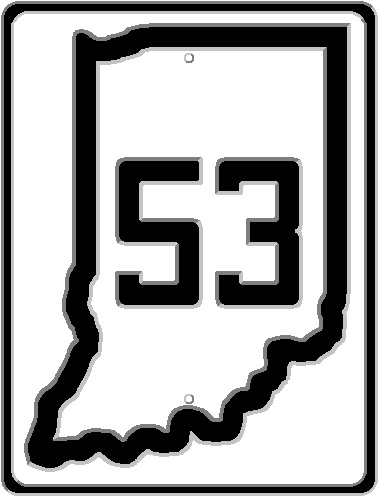
Road Trip 1926: SR 53

Today’s Road Trip 1926 focuses on a road that would only exist until 1934. In 1934 it would become US 152, only to return four years later.

The published description of the new State Road 53 was as follows: “State Road 53 – Crown Point to Montmorenci, by way of Hebron, Demotte, Kersey, Aix, Rensselaer, Remington and Walcott. (Now known as State Roads 8 and 45.)